


"When I first came here, this was all swamp. Everyone said I was daft to build a castle on a swamp, but I built it all the same, just to show them. It sank into the swamp. So I built a second one. That sank into the swamp. So I built a third. That burned down, fell over, then sank into the swamp. But the fourth one stayed up. And that's what you're going to get, lad, the strongest castle in all of England." ~ King of Swamp Castle, Monty Python and the Holy Grail
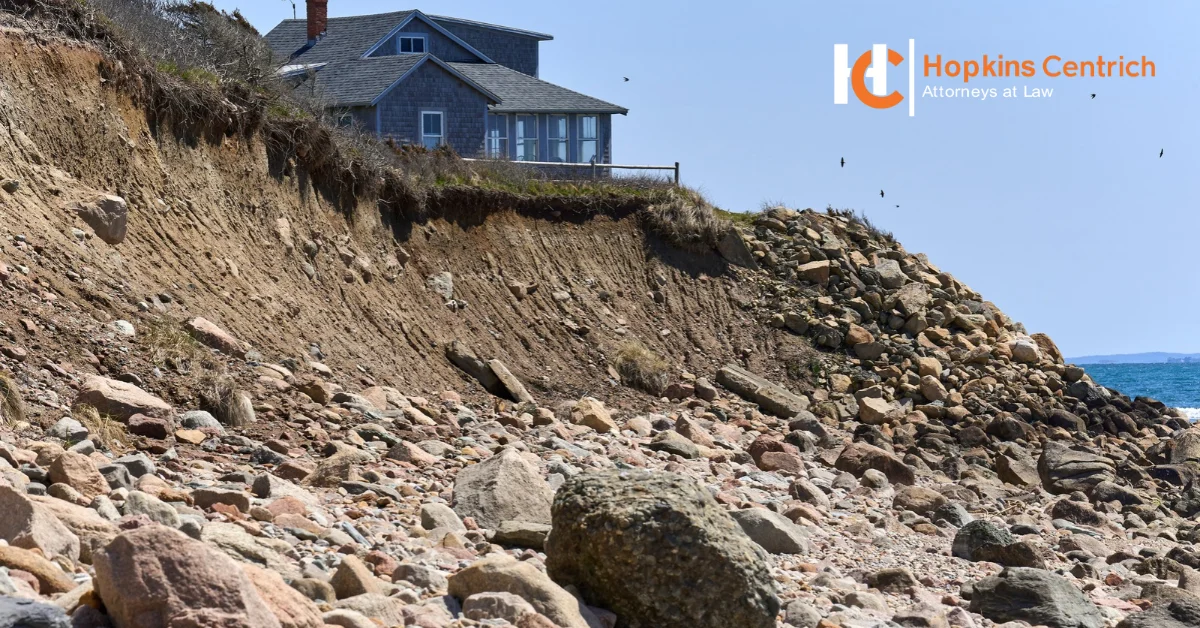
In 2010, Mark and Barbara Blasch built a 5,000-plus square foot shingled house on top of a sand bluff in Wellfleet, Massachusetts, at the far end of Cape Cod. The National Park Service sued to stop them. Half the town hated the thing. Like the Swamp King’s castle, everyone told them they were daft. The lawsuit failed and they built it.
A House at the Edge of a Cape Cod Bluff
Almost immediately upon completion, the bluff started washing out from under the house. The town refused (twice) to let anyone build a seawall. By the summer of 2021, the foundation was less than fourteen feet from the edge. With remarkable optimism, the Blasches put it on the market for $5.5 million.
In an even more remarkable burst of optimism, John Bonomi Jr., a New York attorney, bought it for full price. He borrowed $3.85 million from JPMorgan Chase. He knew the whole history of the place from its origin as a beach shack to the lawsuits to the construction – his mother owned homes in Wellfleet for forty-plus years and was one of the people who fought the construction. He told everyone who would listen that he was sure he could talk the town into the seawall (spoiler alert, he could not). He put another $500,000 into sand which quickly found its way into the bay. In a panic, he tried to sell at a $1 million loss to no avail. With the edge of the bluff inches from his back door, in February 2025 he paid to have the house demolished.
Suing the Bank Over the Mortgage
All that was left was the mortgage. Last October, Bonomi sued Chase in federal court in New York claiming, in essence, that Chase should never have given him a mortgage. Specifically, that he has bipolar disorder, was in the middle of a manic episode when he signed, and the bank knew or should have known he was in no shape to sign anything. Or, as his complaint puts it: "No rational person… would have considered purchasing the Property, and certainly not at the full asking price."
Bipolar disorder is real, reckless spending is one of its textbook symptoms, and courts have let people out of contracts they were in no condition to understand. But: Bonomi is a lawyer, was practicing at the time, had been with the same firm for more than twenty years, and, well, reading what you sign before you sign it is more or less the whole job.
What Was the Bank Supposed to Notice?
One question that’s not really addressed in the complaint: how was Chase supposed to know? Nobody buys a $5.5 million house in an afternoon. There was a mortgage application, income verification, appraisals, inspections, and an engineering report (the finding in a nutshell: “what are you thinking”). Bonomi was the one who rounded them up and sent them along to the bank. It took a couple of months. Unless he conducted the closing like Jason Statham in Crank (keep that heart rate up or die) it's hard to say what a loan officer was supposed to notice, never mind act on.
After the closing he made the payment, $21,053.05, every month for almost three years. He stopped in September 2024 because, in his complaint's words, "it was becoming clear the home likely was not going to be salvageable." Put another way, he paid as long as there was a house to save and quit the month it was obvious the bay was going to win (when has it ever lost?), which is the kind of sharp acumen you'd want in, say, a lawyer. A Fordham law professor made the same point to the Boston Globe in politer terms, adding that courts tend to notice when someone lives with a contract for years before deciding he never really made it.
Chase's entire response so far is that it denies everything and “leaves Plaintiff to his proofs.” Bonomi's own lawyer told the Globe he doesn't know of a case where this argument has ever gotten anyone out of a mortgage.
The Bank’s Homework Is for the Bank
For today we'll leave it at this: the bank at your closing has done a lot of homework on your deal, every bit of it for the bank. The appraisal, the engineers' reports, the underwriting all answer one question, whether the bank gets paid back, and not one of them is somebody telling you the house is a good idea. That job belongs to whoever you bring with you, before you sign.
The same holds in Texas, and on far more ordinary deals than a $5.5 million house on a disappearing bluff. A business owner buying a building, signing a long-term commercial lease, or putting money into someone else’s development gets a stack of reports at closing, and every one of them was ordered by someone else for someone else’s reasons. Your own real estate review – title, survey, engineering and environmental issues, zoning, what the seller is and isn’t actually promising – is the only part of the file working for you.
Arguing afterward that you never should have signed is a much harder case. Texas courts ask whether a person understood the nature and consequences of what he was signing at the moment he signed it, and someone who keeps performing a contract for years makes that argument harder with every payment.
The Second Castle
Bonomi still owns the lot. As for a second castle, building anything there would take the approval of the same town and the same Park Service, and the mortgage on a lot now appraised by the town at $385,000 runs $21,053.05 a month through December 2051.
Talk to Hopkins Centrich
Bring us in before you sign. Hopkins Centrich handles real estate transactions and disputes for business owners in The Woodlands and across Texas, and we would much rather read the engineering report with you than the complaint afterward.